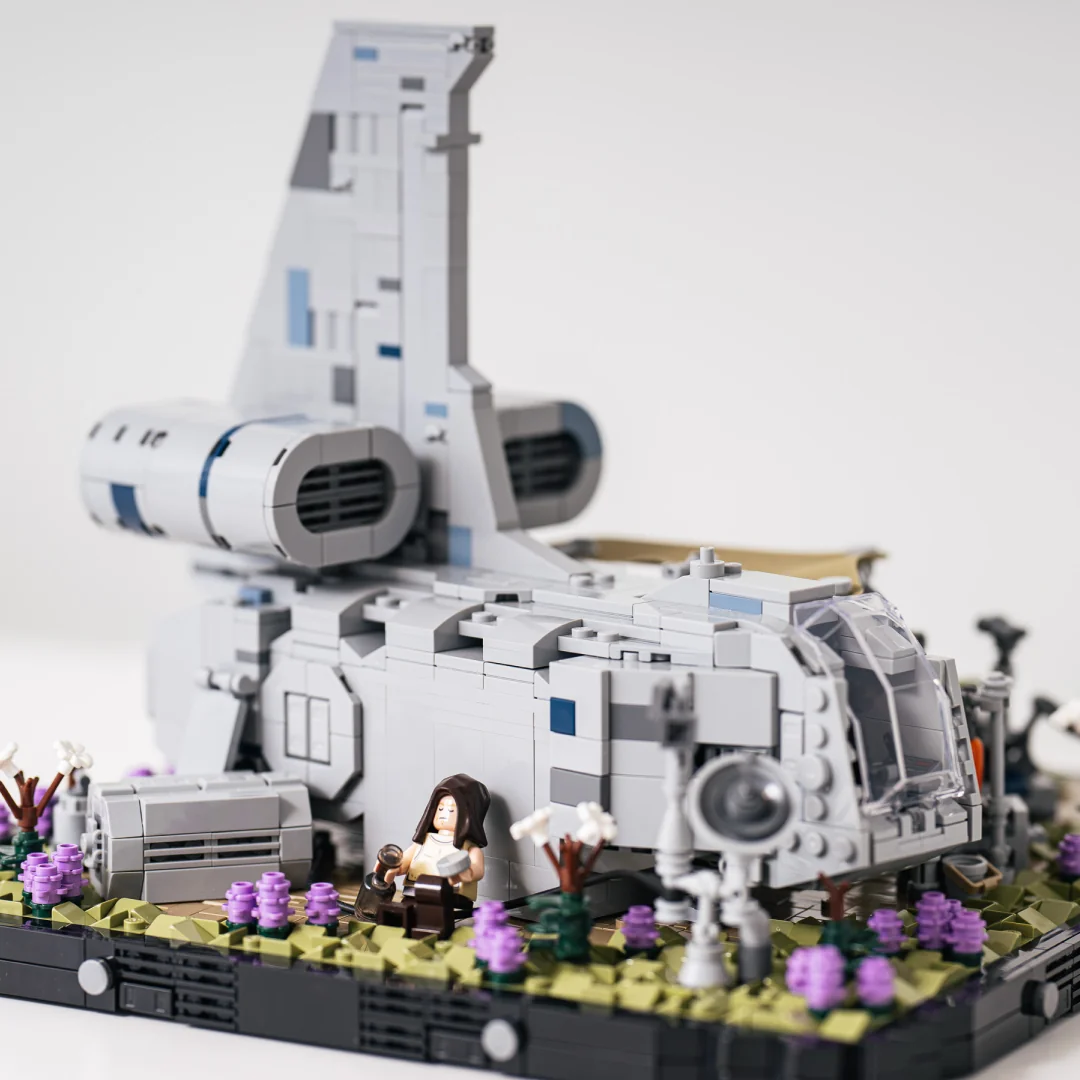
A LEGO diorama should spark interest at every distance. From across the room, its shape, color, or lighting should pull you in. As you move closer, the details should begin to reveal what is happening, who the characters are, and what might have occurred just before you arrived.
Ships and vehicles often provide that initial attraction, but minifigures bring the scene to life. Their placement, poses, eyelines, and interactions can guide viewers through the diorama and encourage them to imagine what happens next.
I also like to reward people who take the time to explore. An iconic scene, a memorable side character, or a hidden joke can turn looking at a model into an experience, with every discovery adding another layer to its story.
Start with something that pulls viewers in
I love designing Star Wars-inspired ships and vehicles, especially working through their small details and play features. But a ship displayed by itself does not necessarily tell a story. That realization is what drew me to dioramas, which have become my favorite storytelling format.
In many of my scenes, the ship is the invitation. Its silhouette or color catches your eye from a distance. Once you approach it, the surrounding environment and characters take over.
In “Vader’s Late,” Darth Vader’s iconic TIE Advanced is the first thing viewers see. The ship establishes the location and immediately identifies the central character. But the story is not really about the ship, it’s about why Vader is late, and how everyone around him is reacting.

Photo by Ben Gebo (bengebo.com)
Let every character contribute
Every minifigure I place has a purpose, even if that purpose is simply to react to someone else.
At the center of “Vader’s Late” is an unhappy Darth Vader confronting the officer apparently responsible for the delay. Around them, smaller reactions expand the moment. One officer tries to remain calm. Another holds a hand behind his back, signaling the Death Troopers to wait. The troopers lean their helmets toward one another as if quietly discussing what they are witnessing, while two nearby Stormtroopers make a determined effort to mind their own business.
Even the back of the diorama continues the joke. Two officers race past the hangar before slowing down to peek inside. They are Tag and Bink, comic characters with a habit of being in the wrong place at the wrong time. Their appearance is a small Easter egg for dedicated Star Wars fans.
None of those characters changes the main event. Together, however, their reactions make the scene feel inhabited. They also give viewers several discoveries to make instead of only one central story.
Go behind the build of “Vader’s Late”, including how I designed the hangar and its character-driven scenes, on Patreon.
Use one detail to suggest a larger conflict
The R93 Refractor is one of my favorite ships from the Star Wars Outlaws video game. Rather than letting it sit alone on a shelf or convention table, I wanted to give it a setting that said something about the world it belongs to.
I returned to the game for inspiration and settled on Myrra City. Its lavender flowers complement the R93’s dark-purple accents, while its rounded colonnades and landing platforms contrast with the ship’s striking silhouette.
But Myrra City has another side. Beneath the city’s beauty is a population living under Imperial occupation.
Instead of simply placing a few Stormtroopers in the scene, I added a custom tile from FireStar Toys depicting Rebel graffiti painted over an Imperial sign. A nearby character is caught actively spraying it. It is a very small moment, but it changes the meaning of the entire setting. The city is no longer just an attractive backdrop: there is resistance here.
That detail also raises a question. What has brought Kay Vess and the R93 into the middle of this conflict?

Photo by Ben Gebo (bengebo.com)
See how I designed the R93 Refractor and built its Myrra City setting in the complete Patreon build guide.
Guide viewers with eyelines
My Mos Eisley diorama began as a way to display my down-scaled modification of the UCS Mos Eisley Cantina. It eventually grew into a much larger environment, with several buildings and many overlapping stories.
One of those stories recreates the iconic “These aren’t the droids you’re looking for” scene with Luke, Obi-Wan, and the Imperial patrol. Behind them, near the cantina entrance, is a custom BoShek minifigure casting a nervous sideways glance at the Stormtroopers.
That glance is deliberate. Painters, illustrators, and filmmakers often use a character’s eyeline to direct the audience toward another part of the composition. The same technique works in a LEGO diorama. BoShek’s expression connects him to the confrontation nearby and helps move the viewer from one scene into the next.
A crowded diorama does not need every character to participate in the same event. Small gestures and shared glances can make separate moments feel as though they are happening in the same world at the same time.

Make room for humor and ordinary life
Not every story needs to be a chase, confrontation, or act of rebellion. Smaller, funnier scenes can make a fictional location feel more real.
One side of my Pirate Space Station diorama contains a small hangar filled with kitbashed Ugly starfighters, support personnel, and droids going about their work. On the other side, viewers can peer into the station’s interior, and discover a karaoke room.
The room provides a change in tone and suggests how the pirates might decompress after a long day. The singer is belting out a favorite tune, one pirate is laughing so hard he is crying, and another is already queuing up the next song.
This moment does not advance a grand plot. It does something equally useful: it gives the characters lives beyond their ships and battles. The surprise of finding it also rewards viewers who explore every side of the model.

Tour the Pirate Space Station and see how I designed Hangar Besh, my largest diorama, in the complete Patreon build guide.
Make the action readable at a glance
When a diorama captures action, the characters’ poses should make that action immediately understandable.
My “Escape of the R-41 Starchaser” diorama features a raised landing pad above a round structure on the outskirts of an outpost. A pirate is making a speedy getaway while an ISB officer and two Stormtroopers close in.
The ISB officer points toward the doorway, clearly ordering the troopers to move. One Stormtrooper kneels to provide cover while the other prepares to advance. Custom arms and legs help strengthen those poses, but the important part is what the silhouettes communicate: point, cover, move.
Viewers do not need a written explanation to understand the immediate objective. The poses establish who is in charge, where the danger lies, and what is about to happen.

See how I designed the R-41 Starchaser, its outpost, and the unfolding escape scene in the complete Patreon build guide.
Build the moment before and the moment after
The most effective dioramas do not explain everything. They show one carefully chosen moment and leave enough unanswered for viewers to complete the story themselves.
A ship can pull someone toward the model. A minifigure’s expression can reveal the tension. An eyeline can lead into another scene. A hidden joke can reward closer inspection. A clear gesture can suggest what will happen in the next few seconds.
The goal is not to fill every stud with activity. It is to give viewers enough clues that they begin imagining the parts of the story they cannot see.