
Scale and Proportion of LEGO Ships and Vehicles
Recreating a ship or vehicle in LEGO is rarely as simple as copying what appears on screen. Sometimes official dimensions are available and other times the only evidence is a brief background appearance or a piece of concept art. Even when the exact scale cannot be determined, the model still needs to look proportionally correct.
I use three main approaches to establish the dimensions of a model: working from published specifications, comparing the subject with objects of a known size, and allowing a particular LEGO element to determine the model’s proportions.
1. Calculating LEGO Scale From Official Dimensions
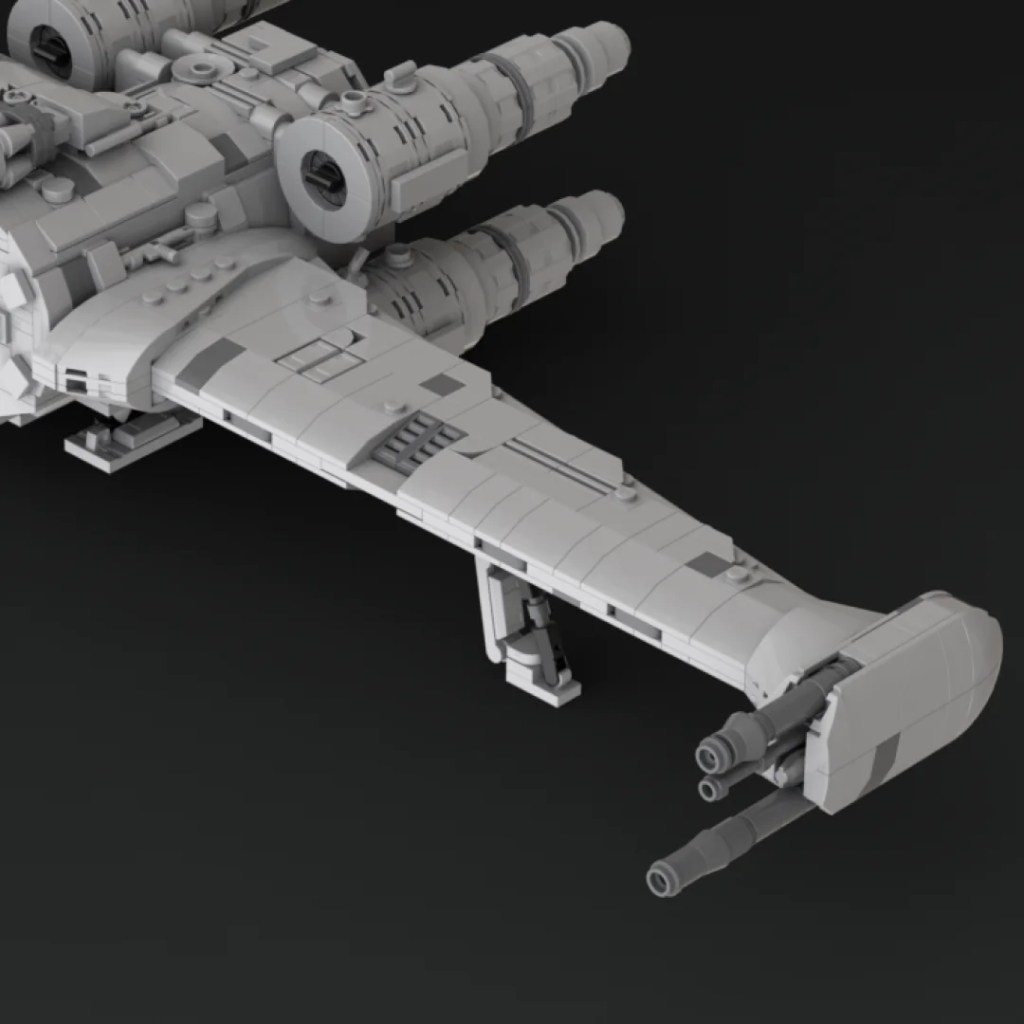
Star Wars canon and Legends contain a wealth of information about ships and vehicles, so official lengths, widths, and heights are often available. This was the case when I redesigned the wing for my BUT-Yt kitbashed Ugly, which uses the large wing from a B-Wing. The dimensions of the wing itself were not published, but the B-Wing’s overall width was listed as 16.9 meters.
The first step is choosing a scale. I normally design at approximately 1:41 scale, meaning that 41 units on the full-size ship become one unit on the model. This is often referred to as minifigure scale and is close to the scale of the UCS Millennium Falcon, whose size works particularly well with LEGO minifigures.
To convert a full-size measurement into LEGO studs at 1:41 scale, multiply it by 125 (the number of 8mm studs in one meter) and then divide the result by 41.
Stud dimensions = (full-size dimension in meters * 125) / 41
For the B-Wing, the calculation produces an overall width of approximately 51.5 studs.

Once one dimension is known, the other dimensions can be calculated from a plan-view illustration. I import the illustration into a design tool such as Figma and measure the know width in pixels. In this example, the B-Wing’s 51.5 stud width measured 935 pixels in the illustration. The wing alone measured 528 pixels.
I can then set up a proportion and solve for x:
51.5 studs / 935 pixels = x studs / 528 pixels
That gives the wing a width of approximately 29.1 studs, which I rounded down to 29 studs.
As long as you have an accurate plan-view illustration and at least one real-world dimension available, this process can be used to calculate the remaining dimensions while preserving the subject’s proportions.
Designing my 50th kitbashed Ugly
See how these measurements shaped the final design of my BUT-Yt kitbashed Ugly, including the redesign of its B-Wing-inspired wing.
2. Estimating LEGO Ship Scale Through Visual Comparison
When a ship has no published dimensions, you can estimate its size by comparing it with something of known size. I used this approach when designing the D-85 Freighter.
In The Mandalorian Season 1 Chapter 3, the D-85 is parked near the Razor Crest. Although perspective makes exact measurement difficult, I estimated its width at roughly three-quarters of the Razor Crest’s, which is about 36 studs at 1:41 scale.
To estimate its height, I used a scene from Andor Episode 1, with actor Kieran O’Brien standing nearby. Using his height as a reference suggested a model height of 10–12 studs.
Follow an 8-month design journey
Further study revealed more clues, including docking bay airlocks that appeared to match the Millennium Falcon’s in size, helping establish the ship’s remaining proportions. Patreon members can follow these discoveries and the model’s development through my 13-part design diary and seven-part build diary.

3. Using LEGO Parts to Determine Model Proportions
Sometimes a subject has neither published specifications nor a useful object nearby for comparison. In those cases, I may allow a specific LEGO element to determine the proportions and scale of the entire model.
The D-Wing, designed by concept artist Matthew Savage, is one example. I generally begin this kind of model with the area constrained by the smallest selection of suitable LEGO parts. For a spacecraft, that is often the cockpit canopy.
The D-Wing has a traditional rounded canopy that closely matches LEGO part 92279, Windscreen 7 × 4 × 2 Round with Handle. Selecting that element established the cockpit’s dimensions in studs.
I then imported Savage’s illustration into Figma and measured the cockpit’s width and length in pixels. By comparing those measurements with the known dimensions of the LEGO canopy, I could calculate the sizes of the ship’s other features.
The resulting model does not represent a verifiable real-world scale because the fictional ship has no published dimensions. However, it is proportionally consistent with the original illustrations.
From concept art to LEGO model
Patreon members can go behind the scenes of the D-Wing project to see how the canopy and concept artwork guided the proportions of the finished model.

Finding The Right Balance
No single method works for every ship or vehicle. Published specifications provide the strongest starting point, but visual comparisons and carefully chosen LEGO elements can fill the gaps when those specifications do not exist.
The final measurements also do not need to be mathematically perfect. LEGO geometry will inevitably require rounding, compromises, and occasional changes in scale. The goal is to establish a reliable framework, then make informed adjustments that preserve the character and proportions of the original design.
Creator’s Note
Some images shown here belong to Lucasfilm Ltd. or other rights holders. They’re included to help illustrate design details and historical context of the Star Wars universe, shared here under fair use for commentary and educational discussion. All rights to original media remain with their creators.